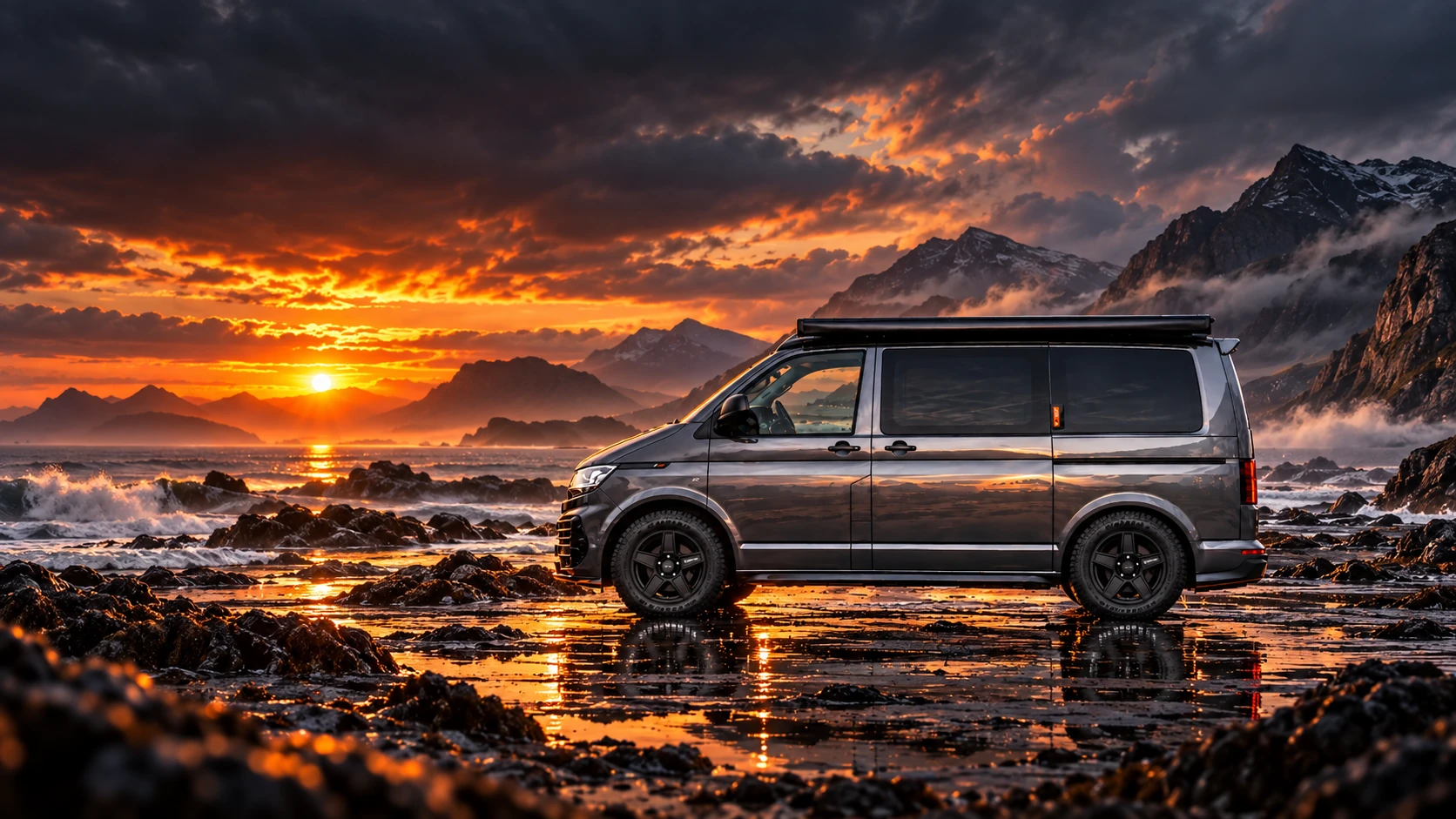

A working van with a second life
Vanilla began as a 2022 Volkswagen Transporter T6.1 SWB Highline: the sensible, proven sort of van that has spent decades earning trust on British roads. Mine has the 110 bhp engine, a five-speed manual gearbox and none of the swagger of a supercar. That is exactly the point. A campervan should feel dependable at six in the morning with rain on the windscreen, not merely impressive beneath showroom lights. Vanilla settles into a journey, returns roughly 30 miles per gallon and carries an extraordinary amount of life inside a footprint that still fits on the drive.
The conversion gives that honest working-van foundation a completely different purpose. The rock-and-roll interior changes from travelling space to living room and then bedroom; the Skyline pop-top opens the roof and the sense of space; carefully used cupboards swallow cables, food, camera bags and the small mountain of kit that every supposedly simple weekend seems to require. It is compact enough to use without ceremony but capable enough to become home for days or weeks. There are larger motorhomes, certainly. Few feel this personal, this nimble or this ready to improvise.
Compact outside. Surprisingly complete inside.
Grey paint, orange punctuation
The Indium Grey bodywork is understated, almost businesslike, but Vanilla was never going to remain anonymous. Black details sharpen the shape and Nix orange appears like punctuation: not everywhere, never by accident, but enough to link the van to the drones, Torque and the whole Nix visual family. Even when the back doors are shut and the equipment is hidden, she still looks like the same character who appears throughout this site—calm, practical and just a little mischievous.
The name matters too. Calling her Vanilla is a joke with a useful twist. From a distance she may look like a straightforward grey Transporter, yet open the door and she is anything but plain. She is camera store, kitchen, charging station, cinema, shelter, bedroom, route-planning office and mobile grandstand. Machines earn names when they become part of the stories rather than merely the way of reaching them. Vanilla has earned hers many times over, from quick local escapes to long European miles.
Understated is not the same as ordinary.
Making a quiet pitch properly useful
Off-grid camping sounds romantic until the camera batteries are empty, the phone is fading and tomorrow’s route is trapped inside a powerless screen. Vanilla’s electrical system turns that problem into part of the fun. A 110 Ah AGM leisure battery sits at the centre, supported while driving by a Victron Orion Smart 30 A DC-to-DC charger. A Victron SmartShunt shows what is really happening rather than relying on guesswork, while a SmartSolar MPPT 75/15 draws useful energy from the solar setup. There is a 60 W panel on the roof for steady background work and a 160 W portable panel that can be aimed towards the best light when camp becomes a longer stay.
The Sargent EC155 manages the familiar campervan services, and the Jackery power stations add a second, movable layer of electricity. That matters because Nix trips are not low-tech retreats. They involve drone packs, controllers, action cameras, phones, lights, a MacBook, 5G equipment and sometimes an induction hob. Power has to be available without turning the van into a humming laboratory. The aim is not to carry electricity for its own sake; it is to make the beautiful no-hook-up pitch as practical as the convenient one with a socket. Solar quietly earns tomorrow’s flight while today’s footage is copied, checked and enjoyed.
The best pitch does not always come with a plug.
Headquarters when the weather turns
For Nix Drones, Vanilla is the point where enthusiasm becomes an organised flight. Nemesis, Zoom, Sneaker and Twitch can travel protected from the loose, wet and muddy world outside. Batteries and controllers have known places. Cameras can be prepared without balancing them on a gatepost. Maps, airspace, wind, nearby people, roads and wildlife can be considered while warm and dry, and a promising launch can be rejected without the pressure that comes from already standing in the rain. Good aerial work often begins long before the propellers move.
After landing, the same cabin becomes a review room. Memory cards are checked, batteries are rotated, flight notes are made and the strongest clips can be backed up before the next location. The DJI Action 4, Canon EOS 70D, phone and Ray-Ban Meta glasses bring in the ground-level parts of the story, so there is usually more media than one aircraft alone could create. Vanilla holds that little production together. If rain arrives sideways, the day does not simply end; the kettle goes on, the forecast is reconsidered and the plan changes. That is a far better definition of mobile operations than covering the van in serious-looking stickers.
Launch site, edit suite and tea room—often within ten minutes.
Small comforts, big difference
Adventure is easier to repeat when it does not require suffering. Vanilla carries a 50-litre compressor fridge, a CAN hob and sink, a Porta Potti 335 and Webasto diesel heating. Those are not glamorous items on a specification sheet, but together they change a cold lay-by morning, wet campsite evening or late festival return into something civilised. Breakfast can happen before the first flight. A hot drink can follow a muddy ride. The fridge keeps proper food and, when the occasion calls for it, a sensible reserve of Rattler cold.
The entertainment setup is gloriously excessive for a short-wheelbase van. A Nebula Capsule 3 Laser projector, 50-inch screen, Fire TV and paired Sonos Roam speakers can turn the interior or awning into a travelling cinema. The ZTE 5G hotspot keeps maps, messages, weather and streaming alive when the signal allows. None of this is there to avoid the outdoors. It extends the day after darkness, rain or tired legs have called time. Vanilla can spend the afternoon as a flight base, the evening as a tiny cinema and the night as a warm bedroom, then be packed down for the road again in the morning.
A campervan should make rough weather interesting, not merely survivable.
Festivals, Europe and the useful detour
Vanilla has carried the Nix story far beyond a single campsite. She has handled British weekends, CamperJam, Dubbed Out and simple nights close to home when the need to get away mattered more than the mileage. Tackeroo on Cannock Chase is a perfect example: close enough to be easy, wild enough to reset the week, and positioned for drones, walks and a Torque ride towards The Horns. The journey does not need to cross a border to count. Sometimes five miles from the front door is exactly far enough.
Then there are the larger maps. Scotland, Cornwall, North Wales and a twelve-country European drift have turned Vanilla into a moving line through landscapes, ferry terminals, old cities, mountain roads and pitches found late in the day. She makes detours affordable because the essentials travel with her. A viewpoint can become lunch; a quiet stop can become the night; a change in weather can redraw the route without ruining it. Traditional touring freedom and modern technology meet in the same small cabin: paper-map instinct backed by live navigation, solar charging, 5G and a weather forecast that is occasionally listened to.
The road is not dead time. It is the chapter between places.
When Vanilla carries Torque
The detachable towbar and Towzer, the Thule bike rack, let Vanilla add another layer to the expedition. Torque rides outside; the living space stays usable; and a trailhead that would be awkward from home becomes tomorrow morning’s starting point. This combination changes the scale of an eMTB weekend. Vanilla covers the motorway and carries food, dry clothes, tools and charging power. Torque takes over where the road becomes track, reaching woodland, viewpoints, pubs and camera positions that would be less rewarding on foot.
Together they create a neat Nix sequence. Vanilla reaches the landscape. Torque gets inside it. The drones rise above it. The finished story can move from road-level arrival to handlebar-height action and then to the wide aerial reveal that explains where everything fits. None of the machines replaces the others; each expands the next one. It is a practical system, but also a wonderfully elaborate excuse to explore somewhere new. North Wales, Scotland and eventually Scandinavia all become more interesting when the van is basecamp, the bike is local transport and the sky is part of the camera kit.
Road. Trail. Sky. One expedition, three viewpoints.
Freedom with cupboards
Vanilla is not a luxury hotel squeezed into a parking space, and she does not need to be. There are compromises: every object must earn its cupboard, every bed conversion involves a small ritual and every new gadget begins a negotiation with the available space. That discipline is part of the charm. The van rewards preparation without demanding a rigid plan. Fill the water, charge the systems, load the right bags and the front door can lead to a completely different morning.
More than any single specification, that readiness is what Vanilla contributes to Nix Drones. She turns ideas into departures. She makes it easier to wait for better light, stay for the sunset, wake near the trail and bring home enough material to tell the whole story properly. The technology will evolve, batteries will improve and the map will gain new marks, but the principle is pleasingly old-fashioned: carry what you need, look after your equipment, leave room for a brew and keep moving towards something worth seeing. Vanilla is the road-going heart of it all—not background transport, but a character with her own chapter and many miles still to write.
Ready beats perfect. The next road can supply the rest.